Trump defends separating immigrant families amid outcry
 Media playback is unsupported on your device
US President Donald Trump has defended his policy of splitting up families entering the US illegally, defying a growing chorus of condemnation.
Speaking at a business convention, Mr Trump said children have to be taken away if their parents are jailed for illegally crossing the US border.
The president had earlier sparked outrage for tweeting that undocumented immigrants would "infest" the US.
Mexico's foreign minister has called the US policy "cruel and inhuman".
"I don't want children taken away from parents," Mr Trump said on Tuesday during a speech at a National Federation of Independent Businesses event in Washington DC.
But he added: "When you prosecute the parents for coming in illegally - which should happen - you have to take the children away."
He also claimed that separating families was "the only solution" to end illegal immigration, even as he noted that he does not support the practice.
Mr Trump said he wanted to "end the border crisis" by giving border officials the resources to "detain and remove illegal immigrant families altogether".
US immigration officials say 2,342 children have been separated from 2,206 parents from 5 May to 9 June.
Mr Trump has blamed "Democrat-supported loopholes" in federal law for the family separations, but critics of the policy say the recent spike is due to the enforcement of US Attorney General Jeff Sessions' "zero tolerance" approach.
Mr Sessions has rejected claims US holding centres for child migrants separated from parents are like Nazi concentration camps.
America's top law official told Fox News the "zero tolerance" policy was about enforcing border security.
Mr Trump is meeting Republican lawmakers later to discuss a bill that proposes to curb the policy.
- Psychological impact on separated children
- Mixed messages on US migrant policy
- Why US is separating migrant children from parents
Mr Sessions was asked on Fox News about a tweet by former CIA Director Michael Hayden likening what happened at Auschwitz concentration camp, where millions of Jews and other minorities were killed, to the separation of undocumented immigrant families at the US border.
 Media playback is unsupported on your device
"Well, it's a real exaggeration, of course," the Department of Justice chief said in Monday night's interview.
"In Nazi Germany, they were keeping the Jews from leaving the country."
Mr Sessions said: "Fundamentally, we are enforcing the law. Hopefully people will get the message and not break across the border unlawfully."
- Who decided to take the children away?
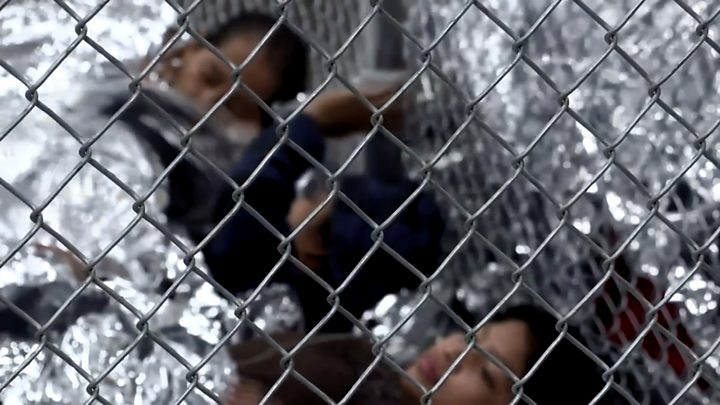
- Fenced enclosures hold migrant children
In a remark that provoked criticism, Fox News host Laura Ingraham said the detention centres were "essentially summer camps" for migrant children.
It is not the first historical analogy inspired by the policy - former US First Lady Laura Bush has compared it to the internment of Japanese-Americans during the Second World War.
Mr Trump tweeted on Tuesday that immigrants threatened "to pour into and infest our Country", triggering further outrage.
Skip Twitter post by @RosLehtinen
No, @POTUS, saying immigrants “infest” our country is repugnant, reprehensible, + repulsive. To dehumanize those who wish to make a better life for themselves + their families flies in the face of decency. The real infestation is only one of your baseless rhetoric
— Ileana Ros-Lehtinen (@RosLehtinen) June 19, 2018
Report
End of Twitter post by @RosLehtinen
What are migrants' countries of origin saying?
Mexican Foreign Minister Luis Videgaray Caso said on Tuesday the separation of children from parents at the US border was "cruel and inhuman", and clearly violated human rights.
The Salvadoran foreign ministry issued a statement on Monday saying the US policy was "exposing children to extremely adverse conditions".
Honduran President Juan Orlando Hernandez said: "Our position is that families should not be separated."
Guatemala has refrained from criticising the US, saying only that it respects other nations' migration policy.
 Media playback is unsupported on your device
What is the policy?
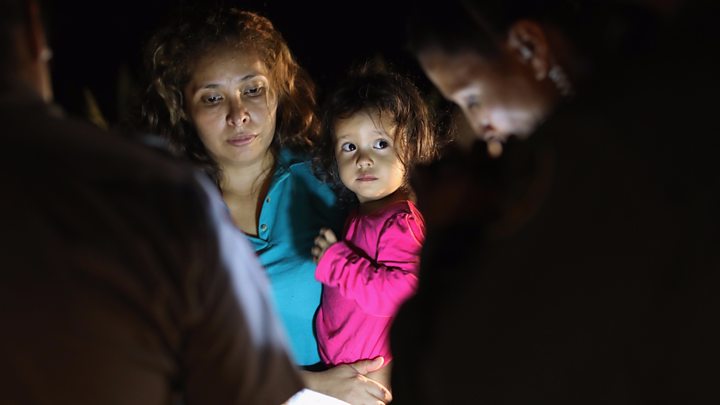
Under the "zero-tolerance" crackdown that the Trump administration rolled out in May, all border crossers - including first-time offenders - are criminally charged and jailed.
Migrant children are not permitted to be incarcerated with their parents, and are kept in separate facilities maintained by the Department of Health and Human Services.
Under previous US administrations, undocumented immigrants caught crossing the border for the first time tended to be issued with court summonses.
But the Trump administration points out that most of those migrants never showed up for court.
The Trump administration has been disputing the terminology used to describe its immigration crackdown.
The Department of Homeland Security has framed it as an "initiative" rather than "a policy".
It describes the holding centres where children have been pictured behind metal chain-link enclosures with concrete floors as "shelters" instead of "cages".
A lawyer defending the detained immigrants tells the Boston Globe that several of her clients had been told by Border Patrol agents that their children were being taken to be bathed - a tactic that has drawn further comparisons to the Holocaust.
As the hours passed the mothers began to realise their children were not going to be immediately returned, according to lawyer Azalea Aleman-Bendiks.
What are Trump and lawmakers doing?
On Tuesday afternoon, the Republican president is due to head to Congress, which is controlled by members of his party, as the House of Representatives prepares this week to vote on a moderate immigration bill.
The compromise measure would limit, but not outright ban family separations. It would also offer an eventual path to citizenship for undocumented adult immigrants, known as Dreamers, who entered the US as children.
The Republican legislation would also provide $25bn (£19bn) in funding for border security, including Mr Trump's planned US-Mexico wall.
The White House says Mr Trump supports the package.
A hardline conservative immigration bill is also in circulation, though it lacks enough support to be politically viable.
Meanwhile, 21 Democratic state prosecutors demanded on Tuesday that the Department of Justice end the "zero tolerance" policy, arguing it "is ignoring its legal and moral obligation for the sake of a political agenda at the expense of children".
"Put simply, the deliberate separation of children and their parents who seek lawful asylum in America is wrong," the letter from the attorneys general reads, adding that the practice is "contrary to American values".
More on US immigration
 Media playback is unsupported on your device
- Trump's blame game on separating families
- Do other countries separate migrant families?
- WATCH: Where do undocumented US migrants live?
Was your family split up after entering the US? Are any of your family members currently being detained and kept apart? Email haveyoursay@bbc.co.uk.
Please include a contact number if you are willing to speak to a BBC journalist. You can also contact us in the following ways:
- WhatsApp: +44 7555 173285
- Tweet: @BBC_HaveYourSay
- Text an SMS or MMS to 61124 or +44 7624 800 100
- Please read our terms & conditions and privacy policy
Or use the form below
Your contact details Name (optional) Your E-mail address (required) Town & Country (optional) Your telephone number (optional) Comments (required)
If you are happy to be contacted by a BBC journalist please leave a telephone number that we can contact you on. In some cases a selection of your comments will be published, displaying your name as you provide it and location, unless you state otherwise. Your contact details will never be published. When sending us pictures, video or eyewitness accounts at no time should you endanger yourself or others, take any unnecessary risks or infringe any laws. Please ensure you have read the terms and conditions.
Terms and conditions
The BBC's Privacy Policy