Koko: Gorilla death coverage rekindles language debate
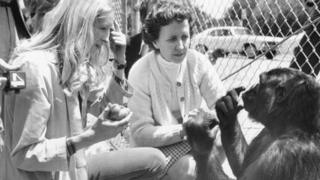 Image copyright Getty Images
 Koko, the celebrated western lowland gorilla, died at the age of 46 this week. Many people paid tributes to her by praising her signing skills. She's famous for her signing skills, but all is not what it seems.
Her death resonated with many people, with videos showing her communicating with her trainers being shared widely on social media.
In many obituaries, it was claimed that she "mastered" American Sign Language, using over 1,000 signs, but some experts said the headlines praising her sign language skills were rather inaccurate.
Skip Twitter post by @BBCArchive
Koko the gorilla, who is said to have been able to communicate by using more than 1,000 hand signs, has died in California at the age of 46. Here she is on BBC News in 1985, with her kitten friend. pic.twitter.com/HA4dFrqlW7
— BBC Archive (@BBCArchive) June 21, 2018
Report
End of Twitter post by @BBCArchive
When she was about 12 months old, animal psychologist Francine "Penny" Patterson started to train her to use a version of American Sign Language. Her instructors said Koko used it to convey thoughts and feelings.
Ms Patterson and her researchers documented that the gorilla understood some 2,000 words of spoken English. The abilities of the gorilla apparently to understand spoken English were documented by Ms Patterson and her researchers.
However, sceptical linguists and scientists questioned Patterson's methods. They also debated how much of Koko's communication actually came from herself or how much we projected ourselves onto her.
When Koko's death was announced, many news organisations, including the BBC, wrote headlines such as "Koko: Gorilla who mastered sign language" and "Koko, famed gorilla that learned sign language".
Many social media users complimented her on her supposed language skills, but not all were convinced that she was actually using sign language. However, many people were impressed by her communication prowess.
Skip Twitter post by @johnrstephenson
Tweets on the death of #Koko the gorilla show we have depressingly far to go in public & journalistic understanding of what #signlanguage is: i.e. another way of expressing #language, just as spoken language does. It's not a set of crude gestures that your captive ape can master.
— John Stephenson (@johnrstephenson) June 21, 2018
Report
End of Twitter post by @johnrstephenson
Skip Twitter post by @linasigns
The information is misleading. Koko did not master “sign language.” She only learned some signs in American Sign Language, but not all of it. Please double-check your facts.
— Lina (@linasigns) June 21, 2018
Report
End of Twitter post by @linasigns
University of Birmingham's Dr Adam Schembri said the headlines need "to be worded with care to avoid crating a misleading impression." He said Koko "did not learn sign language", but she mastered a number of modified American Sign Language signs, which is not the same as American Sign Language.
Skip Twitter post by @KatBrockway
Outstanding. A wave of articles poured on about Koko and how awesome Koko signed 1k BABY SIGN LANGUAGE words. All our lives, deaf folks don’t sign like Koko. We mastered ASL, not Koko. I’m not here to insult the writers but to hit them with the reality.
— Kathleen L. Brockway (@KatBrockway) June 22, 2018
Report
End of Twitter post by @KatBrockway
Marcus Perlman, a linguist, who studied Koko as part of his research into ape communication, weighed in.
Skip Twitter post by @MarcusPerlman
I would say that Koko used an inventory of learned, conventional gestures to communicate effectively with her caregivers about her daily life. Many of her gestures were derived from ASL signs. But yes - Koko certainly did not master anything like a sign language.
— Marcus Perlman (@MarcusPerlman) June 22, 2018
Report
End of Twitter post by @MarcusPerlman
Gerardo Ortega, a sign language researcher, said Koko never mastered sign language. He tweeted: "At most she ritualised the use of some signs about the here and now and used them only after trainer promoted her."
Skip Twitter post by @DLilloMartin
No, @cnnbrk , Koko did not *master sign language*. Whatever other qualities she had, it’s important to be accurate on this point https://t.co/9dnTMohx5x
— Prof. Diane Lillo-Martin, Ph.D. (@DLilloMartin) June 21, 2018
Report
End of Twitter post by @DLilloMartin
However, some sign language users see things differently, especially some people who said she inspired them to learn sign language.
Skip Twitter post by @gillainsteele
Koko is gone and I’m broken. I watched a documentary about her and she drove me to learn sign language to communicate to my friends who are deaf. She’s truly amazing.
— Gillian Steele |-/ (@gillainsteele) June 21, 2018
Report
End of Twitter post by @gillainsteele
Skip Twitter post by @steven_aquino
As someone whose parents were deaf and is fluent in ASL, I find the reverence for Koko and her speaking sign language fascinating. Speaking sign language has always felt perceived as more prestigious than other languages, at least in my experience.
— Steven Aquino (@steven_aquino) June 21, 2018
Report
End of Twitter post by @steven_aquino
Speaking to BBC News, Prof Graham Turner of Heriot Watt University, said: "Serious efforts to teach apes some signing began in the 1960s with researchers attempting to teach individual signs derived from American Sign Language (ASL). And the apes did learn to use some hand gestures in this way.
"But it is a distortion to imply that Koko or any ape has ever learned to use a natural signed language like a human being."
Prof Turner said: "These languages use the face, body and hands in an integrated way, exploiting their multidimensional, spatial medium through the layering of simultaneous and extremely precise visual elements. So communication in ASL or any such signed language entails acquiring command of a far more complex system of linguistic expression.
"That system must also permit the creation of new patterns and sequences - formed within the constraints of the system - for any context that may arise. With this kind of appreciation of sign language structure it is plain that 'signing' apes have never proven capable of displaying grammatical competence comparable to human fluency.
"Although the apes can use two or three signs in a sequence, close inspection of filmed data has repeatedly shown trainers prompting them, and then questionably interpreting separate responses as signed sentences."
Whether she used sign language or not, her command of gestures was extraordinary for a gorilla. She connected not only with some humans but also with animals, especially kittens.