Brexit: Bill approved after May sees off rebellion
 Media playback is unsupported on your device
The government's Brexit bill has finally passed through Parliament after the PM saw off a revolt by Tory MPs.
Peers accepted the amendment to the EU (Withdrawal) Bill sent to them from the House of Commons and the bill now goes for Royal Assent, becoming law.
Earlier, the government won the vote 319 to 303, despite would-be rebels who wanted to ensure MPs had the power to stop the UK leaving without a deal.
Assurances were accepted that MPs will have a meaningful say.
The Department for Exiting the EU said the passing of the bill marked a "crucial step" in the UK's preparations and was a "good moment for all those who want a smooth and orderly exit".
Dominic Grieve, leader of the would-be rebels, said the "sovereignty of Parliament" had been acknowledged.
Both sides have claimed victory with Stephen Hammond, a pro-EU MP who eventually sided with the government, suggesting ministers had agreed to give Parliament a "real say" on top of other concessions.
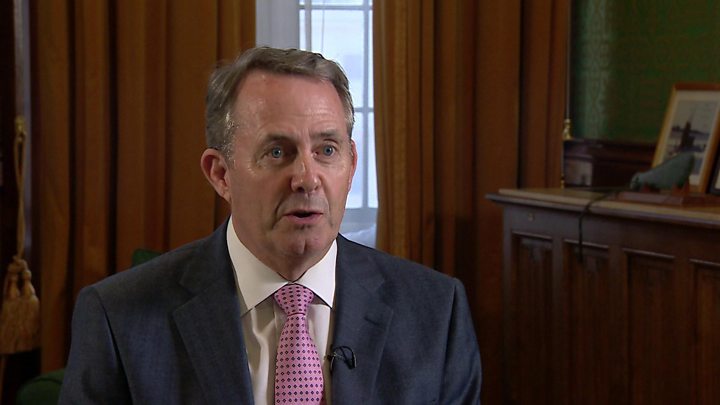
But international trade secretary Liam Fox said nothing had really changed and the option of a no-deal Brexit had been left firmly on the table.
- Live updates: Commons debate on EU bill
- Who really backed down over Brexit vote?
- Can Theresa May 'take back control'?
- Brexit: All you need to know
- Brexit: Your guide to EU jargon
"There is no change to the fundamental issue here which is the government cannot be forced by Parliament to negotiate something which it does not want to do," he told the BBC's political editor Laura Kuenssberg.
He said the government had "to be able to hold out in our negotiations the prospect of no deal" otherwise the EU would get the upper hand.
On Wednesday evening, following the Commons vote, Leader of the Lords Baroness Evans of Bowes Park said the EU (Withdrawal) Bill had been "debated at length" and was very different as a result of amendments tabled by the Lords.
"I believe our role now is to accept their view as expressed in a vote a few hours ago," she said.
Shadow Brexit spokesperson Baroness Hayter of Kentish Town said the Lords have been heard "to quite a large extent" on the matter.
Peers approved the government's proposal without a vote.
The UK is due to leave the European Union on 29 March 2019 and negotiations have been taking place over the terms of its departure.
How the vote unfolded
The government has been at odds with the House of Lords in the long-running row over what happens if the UK cannot reach a deal with the EU, or if MPs reject whatever deal the government agrees with the EU.
But, following Wednesday's vote, the government is a step closer to getting its EU (Withdrawal) Bill - which will end the supremacy of EU law and prepare the UK's statute book for Brexit day - into law.
The Commons vote had been expected to be tight and the government eventually prevailed by a majority of 16.
Six Tory MPs - Ken Clarke, Anna Soubry, Sarah Wollaston, Heidi Allen, Antoinette Sandbach and Phillip Lee - rebelled while four Labour MPs backed the government and six other Labour MPs abstained, as did Kelvin Hopkins, who sits as an independent after having the whip withdrawn.
Ms Wollaston tweeted that she was disappointed with the outcome.
Skip Twitter post by @sarahwollaston
I continue to be concerned about the risks of a cliff-edge, no-deal Brexit which I think would have devastating consequences for individuals, businesses & communities. That is why I voted for Parliament to have a meaningful final vote. I am disappointed by today’s result
— Sarah Wollaston MP (@sarahwollaston) June 20, 2018
Report
End of Twitter post by @sarahwollaston
One Labour MP, Naz Shah, voted in a wheelchair after being released from hospital amid Labour claims that normal arrangements sparing unwell MPs from having to enter the chamber had been abandoned.
Skip Twitter post by @DawnButlerBrent
The truth is the Tories refused to nod her through. This is inhumane treatment. No other workplace would condone this type of working practice. Parliament needs to modernise.
In addition if we had a kinder government.... [insert phrase]https://t.co/Q7WFUYHwma— (((Dawn Butler MP))) (@DawnButlerBrent) June 20, 2018
Report
End of Twitter post by @DawnButlerBrent
The sticking points
The debate centred on what happens in three Brexit scenarios:
- If MPs vote down the UK-EU Brexit deal
- If Theresa May announces before 21 January 2019 that no deal has been reached
- If 21 January passes with no deal being struck.
Under these circumstances, the government has said, a minister will make a statement in Parliament, setting out the proposed next steps.
MPs will then vote on this statement. According to the government, this vote should be "on neutral terms", with MPs simply noting what has been said.
But an amendment backed by the House of Lords on Monday went further, saying MPs should have to "approve" the minister's statement.
The Department for Exiting the European Union has now conceded that it will be up to Commons Speaker John Bercow to decide the matter at the time.
The concession
Speaking in the Commons, Dominic Grieve said the issue of the meaningful vote was about giving "assurances to the House and many, many people in the country who are worried about this process and how it will end".
If Parliament wished to "speak with one voice" and exert its influence in the face of a non-deal scenario, it "has the power to do it".
Mr Grieve said he had insisted on a key paragraph in the government statement accepting "it is open to MPs to table motions and debate matters of concern and that, as is the convention, parliamentary time will be provided for this".
Another potential rebel Nicky Morgan said she did not wish to see Mrs May "destabilised or undermined" ahead of next week's summit of EU leaders.
But she warned of further battles to come over the UK's trade and customs arrangements with the EU and suggested relationships between MPs had been "strained almost beyond belief".
Please upgrade your browser

Your guide to Brexit jargon
Enter the word or phrase you are looking for Search
And Conservative MP Vicky Ford, another pro-European MP who stuck with the government, said the outcome was "not a mandate for a no-deal Brexit".
She said MPs had secured a "backstop" which meant if Parliament rejected the deal it could trigger "another set of negotiations" between the UK and EU aimed at getting an agreement before the UK left.