Universal Credit ‘could cost more than current benefits system’
 Media playback is unsupported on your device
The government's flagship benefits system has been too slow to roll out, causes hardship, and is not delivering value for money, a watchdog has said.
The National Audit Office said the £1.9bn Universal Credit system could end up costing more to administer than the benefits system it is replacing.
Some claimants waited eight months for payment amid the switch to UC, which rolls six benefits into one, it adds.
The government said UC would bring a £34bn return over 10 years.
It said more people would get into work - and stay there longer - and that it had taken a "listen and learn" approach to the introduction of the programme.
The move to UC has long been criticised for its delayed and flawed implementation, with more than 110,000 people paid late in 2017 alone.
 Media playback is unsupported on your device
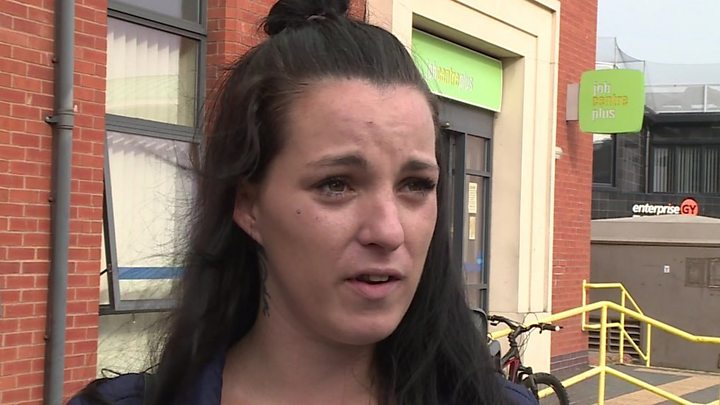
Rebecca Smidmore, a full-time carer for her disabled son, said the system was confusing and had taken more than a year to understand.
One of the problems, she said, was that if her husband's pay day came one or two days early, the UC system calculated that he had earned double the amount for that month.
"In that case our universal credit is heavily reduced," she told Radio 4's Today programme.
"We don't qualify for free prescriptions or dental treatment which we would do normally."
'No alternative'
Meg Hillier, chair of the Public Accounts Committee, said UC had been "one long catalogue of delay with huge impact on people's lives".
And the Child Poverty Action Group questioned whether the government should push on with a programme that was "demonstrably failing".
But the public spending watchdog's report found that so many changes had been made to job centres and working practices that there was no "alternative but to continue".
The government expects UC to deliver £8bn of net benefits annually, but the report said the figure depended on "unproven assumptions".
Ministers would never know if their aim of putting 200,000 extra people in employment, or saving £2.1bn in fraud and error, would work, the NAO said.
It said UC currently cost £699 per claim - four times as much as the government intends to spend when the systems are fully developed.
Five-month delays
And eight years after work began on UC, only 10% of the total number of people expected to claim were on the system, the report said - with one in five not receiving their full payment on time.
A significant minority of those paid late, some 20% - usually the more needy and complicated cases - were waiting five months or more to be paid.
And yet "the Department for Work and Pensions does not accept that UC has caused hardship among claimants", the report said.
- I don't even have 4p to my name
- Theresa May urged to halt Universal Credit
- Charity calls for Universal Credit action
It pointed to a recent internal departmental report that showed 40% of claimants were experiencing financial difficulties.
Analysis of DWP payment data for 2017 revealed that around one-quarter (113,000) of new claims were not paid in full on time.
Late payments were delayed on average by four weeks, but from January to October 2017, 40% of those affected by late payments waited in total around 11 weeks or more.
Some 20% waited almost five months and about 8% had to wait for eight months.
Despite recent improvements, one-fifth of new claimants in March 2018 did not receive their full entitlement on time. Some 13% received no payment on time.
What is Universal Credit?
Universal Credit merges six benefits (income support; income-based jobseeker's allowance; income-related employment and support allowance; housing benefit; child tax credit; working tax credit) into one.
It was designed to make claiming benefits simpler. A single payment is paid directly into claimants' bank accounts to cover whichever benefits they are eligible for.
Claimants then have to pay costs, such as rent, out of their UC payment. It can be claimed by people whether they are in or out of work - but payment decreases as you earn more.
What is universal credit - and what's the problem?
'Financial misery'
A spokesman for the DWP insisted UC was good value and would realise a return on investment of £34bn over 10 years against a cost of £2bn - with 200,000 more people in work.
"Furthermore, 83% of claimants are satisfied with the service and the majority agree that it 'financially motivates' them to work," he said.
Work and Pensions Minister Alok Sharma said the NAO report was written before the introduction of £1.5bn-worth of measures enabling people to get 100% advances on their first UC payment.
Mr Sharma told Today those on housing benefit could also get extra money to help them transition on to UC.
"We've not seen the full impact of these very positive changes," he added.
But Jane Ahrends, of the Child Poverty Action Group, said the NAO presented a "justifiably bleak" picture, urging ministers to "pause for thought".
"Will the government press on with a programme that is demonstrably failing - causing financial misery for families - or will it restore the money that's been taken out of Universal Credit in an effort to rehabilitate it for struggling families."
Emma Revie, chief executive of food bank charity The Trussell Trust, called for more support for "groups of people most likely to need a food bank, and debt advice to be offered to everyone moving on to the new system".
Shadow work and pensions secretary Margaret Greenwood said: "This report shows just how disastrously wrong the Conservatives have got the roll out of Universal Credit."
What are your experiences of being on Universal Credit? Email your comments to haveyoursay@bbc.co.uk.
You can also contact us in the following ways:
- WhatsApp: +44 7555 173285
- Tweet: @BBC_HaveYourSay
- Text an SMS or MMS to 61124
- Please read our terms & conditions and privacy policy
Or use the form below
Your contact details Name (optional) Your E-mail address (required) Town & Country (optional) Your telephone number (optional) Comments (required)
If you are happy to be contacted by a BBC journalist please leave a telephone number that we can contact you on. In some cases a selection of your comments will be published, displaying your name as you provide it and location, unless you state otherwise. Your contact details will never be published. When sending us pictures, video or eyewitness accounts at no time should you endanger yourself or others, take any unnecessary risks or infringe any laws. Please ensure you have read the terms and conditions.
Terms and conditions
The BBC's Privacy Policy